Recruitment office, maid agency and cleaning company software in Qatar: contracts, scheduling, payroll
Akwad Programming builds systems for recruitment offices, maid agencies, manpower and cleaning companies in Qatar on ERPNext, and supports them from Doha. Run contracts, worker bookings, invoices and payroll from the days worked at customers in one system, with apps for your supervisors and drivers.
What slows maid and cleaning companies in Qatar down?
Maid and cleaning companies in Qatar lose time checking worker availability by phone, counting working days by hand and following renewals and refunds on paper.
- Worker availability checked by phone before every booking
- Working days and overtime counted by hand at month end
- Renewals, freezes and refunds followed on paper
- Drivers report pickups and collections by phone
What does a system for maid and cleaning companies include?
Built on ERPNext, so contracts, bookings, invoices and salaries come from the same records.
Contracts
Company, stay-in and flexible contracts, with worker allocation, renewal, freezing, cancellation, refunds and payment schedules.
Scheduling and service orders
Each worker booked by date and shift, with an availability check and orders for daily, flexible, maintenance and deep-cleaning work.
Payroll from days worked at customers
Approved working days and overtime at each customer go straight to the salary slip, with rules for each staff category.
Invoices and collections
Invoices, advance payments, outstanding balances and customer summaries built from the service records.
Supervisor and driver apps
Supervisors handle customers and orders from their phones. Drivers confirm pickups, arrivals and handovers, and record what they collect.
Worker records
Recruitment from abroad and visa steps, ID, visa and health card expiry dates, leave and staff requests with approval signatures, in one record per worker.
Why do maid agencies and cleaning companies in Qatar choose Akwad?
Akwad Programming runs recruitment offices, maid agencies and cleaning companies in Qatar on one ERPNext system, from contracts and bookings to payroll from days worked and WPS files.
- Company, stay-in and flexible contracts, with daily visits booked as service orders
- Recruitment from abroad and visas tracked on each worker's record
- An availability check before every booking
- Salaries from approved days worked at customers, and overtime
- Driver statuses and customer areas in Arabic
- WPS salary files from the same payroll
- Hosting in Microsoft Azure's data centre in Qatar, or on AWS
How do we know which worker is free before we confirm a booking?
Book every worker in the system by date and shift, and let it check availability before the booking goes through. Your coordinator no longer calls around or scrolls a spreadsheet to find out who is free tomorrow morning.
In many maid and cleaning companies, the schedule lives in one person’s sheet and a few message groups. Two customers get promised the same worker, or a worker sits idle because nobody knew they were free.
For a home services company in Qatar, we built a staff appointment log that books each worker for a date and a shift. Before an order is confirmed, the system checks who is free. Orders cover the kinds of work these companies sell:
- daily visits;
- flexible bookings;
- maintenance jobs;
- deep cleaning;
- overtime shifts.
Cleaning companies that serve offices and buildings work the same way: a company contract, regular shifts and the occasional deep-cleaning job, all booked against the same pool of workers. If a worker is replaced, the booking log is updated, so the schedule always shows who is really going where.
How do we manage maid contracts from signing to renewal?
Keep every contract in the system, with its type, its worker and its payment schedule, and make each change there. When a contract is renewed, frozen or cancelled, the schedule, invoices and refunds that depend on it follow, instead of being fixed by hand in three places.
The same company works with company, stay-in and flexible contracts, and books daily visits as service orders. For each contract, the system handles:
| When this happens | What the system does |
|---|---|
| A customer signs | The contract is created and a worker is allocated |
| The customer wants a different worker | The worker is changed and the booking log follows |
| The customer is away for a while | The contract is frozen |
| The contract ends | It is renewed, or cancelled with any refund worked out |
| A payment is due | The payment schedule shows what is owed and when |
Renewals that repeat can be created by the system, so nobody has to remember which contracts end this week.
How do we pay workers for the days they actually worked?
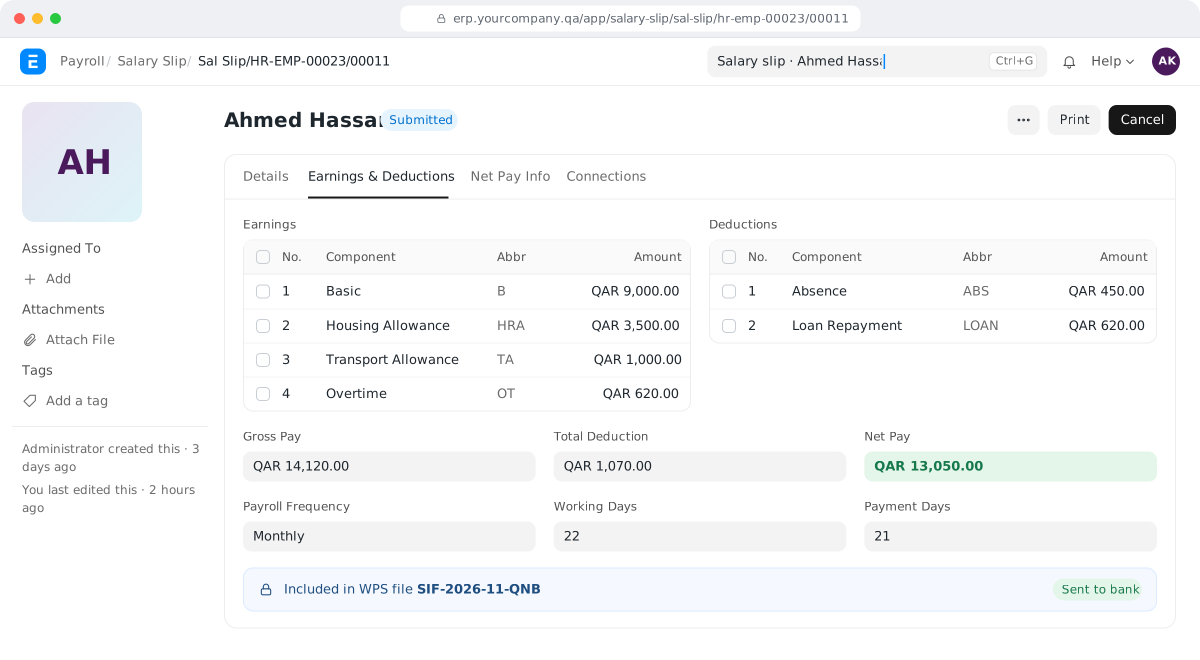
Pay from the days worked at customers, not from an office time clock. Your workers don’t check in at your office; they work at your customers’ homes and premises. So we built a client attendance record that adds up each worker’s approved days and overtime from where they were sent, and passes them to the salary slip in ERPNext HR and payroll.
A worker who served several customers in the month is paid for all of it on one salary slip. Salary structures and overtime rules are set for each staff category, so office, company, stay-in and flexible staff are each paid the right way. At month end, HR doesn’t start from a manual count of days. A working-days report shows the figures behind each salary, and the WPS salary file can come out of the same payroll; our guide to WPS in Qatar explains how that file works.
How do supervisors and drivers work from their phones?
Give each of them a mobile app that does their job and nothing more. The supervisor app is for customers and orders; the driver app is for visits, transport and collections. Neither has to call the office to report what happened.
A supervisor finds the customer, creates an order, and edits, cancels or shares it when the customer asks for a change. A driver opens the day’s visits and sees the customer, the departure and the workers to pick up. They confirm loading, arrival and handover or return, and record what they collect, with any prepaid amount already taken off. The daily collection list can be filtered by date and shows the total. Orders created in the app are the same orders the office sees, so nobody types them in again from a message.
How do invoices and collections stay in line with contracts?
Build invoices from the same service records that drive the schedule. The accounts team works from invoices, advance payments, outstanding balances and a customer summary that already reflect every contract change, so they don’t rebuild a customer’s balance from messages and receipts. When a customer calls about their balance, the accountant can answer while still on the call.
Because drivers record collections in the app, what they collect reaches the office record instead of waiting to be typed in again. Prepaid amounts are applied to collections, so a customer who paid in advance isn’t asked to pay twice.
How do we keep workers’ documents and requests in order?
Keep each worker’s record in the system, with ID, visa and health card expiry dates, and let reminders warn HR before something runs out. Nobody has to go through a file cabinet to find whose papers expire next month.
Leave follows the policies you set, and staff requests go through approval with signatures on the printed form.
What does management see each day?
The general manager’s dashboard shows how many workers are available for each service, so management knows how many people it can offer before taking on new work. HR, operations and finance work from the same contracts, visits and staff records, and the record of days worked at customers drives both the customer’s invoice and the worker’s pay.
We trained the team on invoices, payments, deductions, transfers, expenses and maid contracts, and HR on leave requests. The client signed off the enhancements and, later, both apps.
Read the full story of how we built this with a home services company, or see how ERPNext HR and payroll, our mobile apps, payment gateway integration and the WhatsApp Business API work. See how the whole ERP system in Qatar fits together, and for what an ERP budget covers, read ERP cost in Qatar: what you actually pay for.
How we work with home services companies
- 01
Map your contracts
We follow how a customer signs, how a worker is assigned and reaches the home, how you collect and how you pay your staff.
- 02
Build and connect
We set up ERPNext and Frappe HR, add your contract types and booking rules, and build the supervisor and driver apps.
- 03
Train and support
We train operations, accounts and HR, and stay with you after go-live, starting with a free warranty.
Our projects for home services companies in Qatar
High Class Services: Home services · ERPNext + mobile
Contracts, scheduling and payroll from days worked at customers, with supervisor and driver apps
- Quality Home Medical Care
Quality Home Medical Care: Home healthcare · HR
Nurse recruitment, shift scheduling and attendance for a home healthcare company
ERPNext modules and services for home services companies
- Workers, attendance and payroll
Workers, attendance and payroll: HR & Payroll · ERPNext
- Apps for drivers and field teams
Apps for drivers and field teams: Mobile apps
Apps connected to ERPNext for the people who work away from the office
Systems for home services companies in Qatar: common questions
How much does a system for a maid or cleaning company cost in Qatar?
There are no licence fees for ERPNext. The cost depends on your contract types and booking rules, the number of workers and staff categories in payroll, the supervisor and driver apps, the contracts and workers we bring in, and hosting. We give you a fixed quote after a short review of your needs.
Can we set different prices by contract, day or visit?
Yes. Each order type carries its own price, so a worker's price can be set by contract, by day or by visit, as we set up for a home services company in Qatar.
Can a maid agency message its customers on WhatsApp?
Yes. Akwad Programming is an official Meta WhatsApp Tech Provider, so the system can send customers messages such as booking confirmations and renewal reminders on WhatsApp. Messages go out from your official business number using approved templates in Arabic and English, without staff typing them one by one.
Can customers pay for their contract online?
Yes. We have connected payment gateways used in Qatar, such as SkipCash, QNB, QPay (Qatar Central Bank) and Sadad, so a payment can be recorded against the customer's invoice. The contract's payment schedule then shows what has been paid and what is still due, without the accounts team updating it by hand.
Is the driver app for maid and cleaning companies in Arabic?
Yes. In the driver app, statuses and customer areas show in Arabic, and the screens, documents and reports in the office can be in Arabic and English.
Does the system suit recruitment offices and maid agencies in Qatar?
Yes. Recruitment offices that place maids with families run recruitment from abroad, visas, contracts, worker changes, renewals, refunds and payment schedules in the same system, with document expiry dates on each worker. Offices that also offer daily or flexible cleaning run both kinds of work in one system.
Can we bring our current contracts and workers into the system?
Yes. We bring in your workers with their document expiry dates, your customers, and your open contracts with their payment schedules, so bookings, invoices and payroll start from where you are today.
Running bookings and payroll from spreadsheets?
Tell us how your contracts, bookings and payroll work today, and we'll show you a demo in ERPNext.