ERP for factories and workshops in Qatar: orders, production, costs and payroll
Akwad Programming builds and supports ERP for factories and engineering workshops in Qatar on ERPNext. Link every customer order to production, raw materials and purchasing, record work on the floor, and see what each job really cost, with factory payroll in the same place.
What slows factories and workshops in Qatar down?
Factories and workshops in Qatar slow down when orders are followed on paper, materials are bought twice or late and a job's real cost is known only at month end.
- Customer orders and production followed on paper
- Raw materials bought twice, or bought too late
- The real cost of a job known only at month end
- Attendance and overtime added up by hand for payroll
What does ERP for factories and workshops include?
Built on ERPNext, so sales, production, stores, finance and HR share the same data.
Bills of materials
Each product's raw materials, sub-assemblies and work steps, with its planned cost.
Work orders and job cards
Materials issued from the store, time and quantities recorded for each step, and finished goods added to stock.
Planning and purchasing
A production plan works out what your orders need and raises requests only for the materials you are short of.
Quality checks
Inspections on incoming materials, during production and before delivery, with conformance certificates printed from the system.
Customer documents
Delivery notes and invoices that show the customer's purchase order number, payment details and signatures.
Factory payroll
Attendance from fingerprint devices, overtime, leave and WPS salary files, in the same system as production.
Why do factories and workshops in Qatar choose Akwad?
Akwad Programming sets up ERPNext for factories and engineering workshops in Qatar, with customer order numbers on documents, conformance certificates, fingerprint attendance, WPS payroll and hosting in Qatar.
- The customer's purchase order number on delivery notes and invoices
- Sub-assemblies made in advance and taken from stock
- Conformance certificates printed from the system
- Fingerprint attendance, overtime and WPS salary files
- Two or more companies in one system
- Hosting in Microsoft Azure's data centre in Qatar, or on AWS
How do we link each customer order to production and purchasing?
Start every job from the customer’s order in the system, and create the work order and the material requests from it. Production, the store and purchasing then work from the same order, instead of copying details from a paper job sheet or a WhatsApp message.
In many workshops, the order arrives by email, the job is written on a board, and materials are bought when someone notices they are missing. When the customer calls to ask about their job, nobody can answer without walking to the floor.
For an engineering workshop in Qatar, we set up ERPNext so that:
- the sales order holds the customer’s purchase order number and date;
- work orders and material requests are created from that sales order;
- delivery notes and invoices print the customer’s purchase order number, payment details and signatures;
- the same system runs two companies, each with its own accounts.
When goods leave, the customer sees their own order number on the paperwork, so their accounts team can match your invoice without a phone call.
How does a workshop plan materials for one-off customer jobs?
A workshop plans materials from the customer jobs it has accepted, and a production plan does the counting. It takes your open orders, works out the raw materials and sub-assemblies they need, subtracts what is already in the store or on order, and raises requests only for the shortfall. Your buyer no longer depends on one person’s memory of what is on the shelf.
Sub-assemblies need care. For a paper and plastic factory, some parts are made in advance and kept in stock. We set up the bills of materials so those parts are taken from stock when the finished product is made, not made again. The plan creates work orders only for what really has to be produced. The planning steps are explained in production planning software on ERPNext.
How do supervisors record each customer job’s progress without paper?
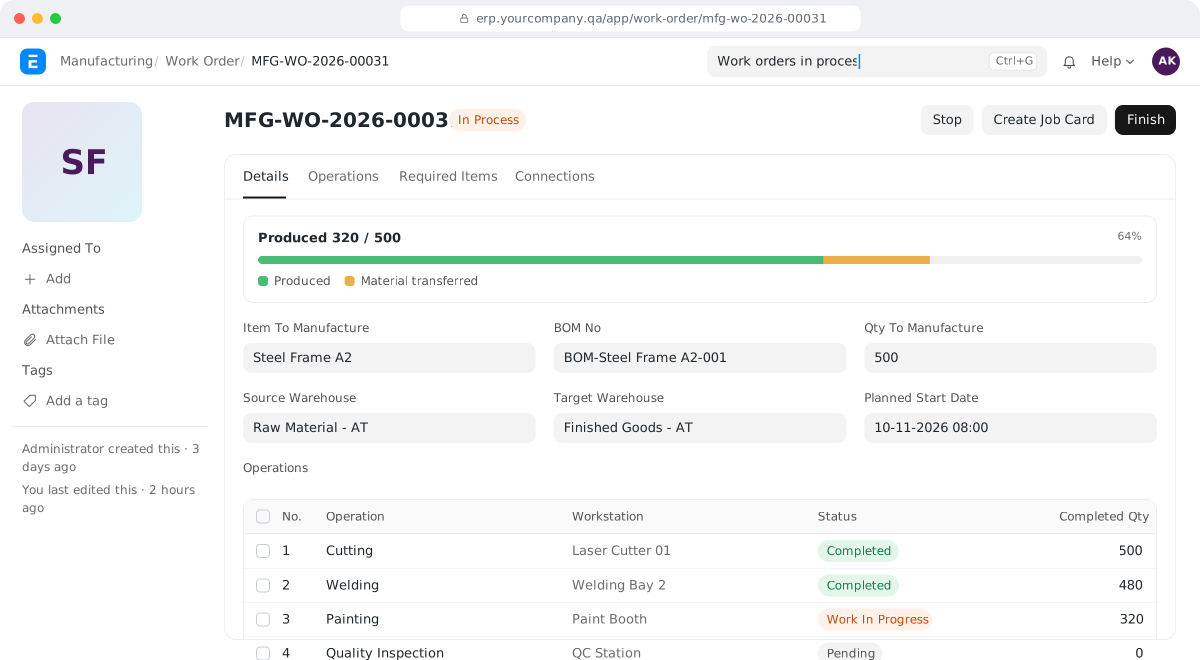
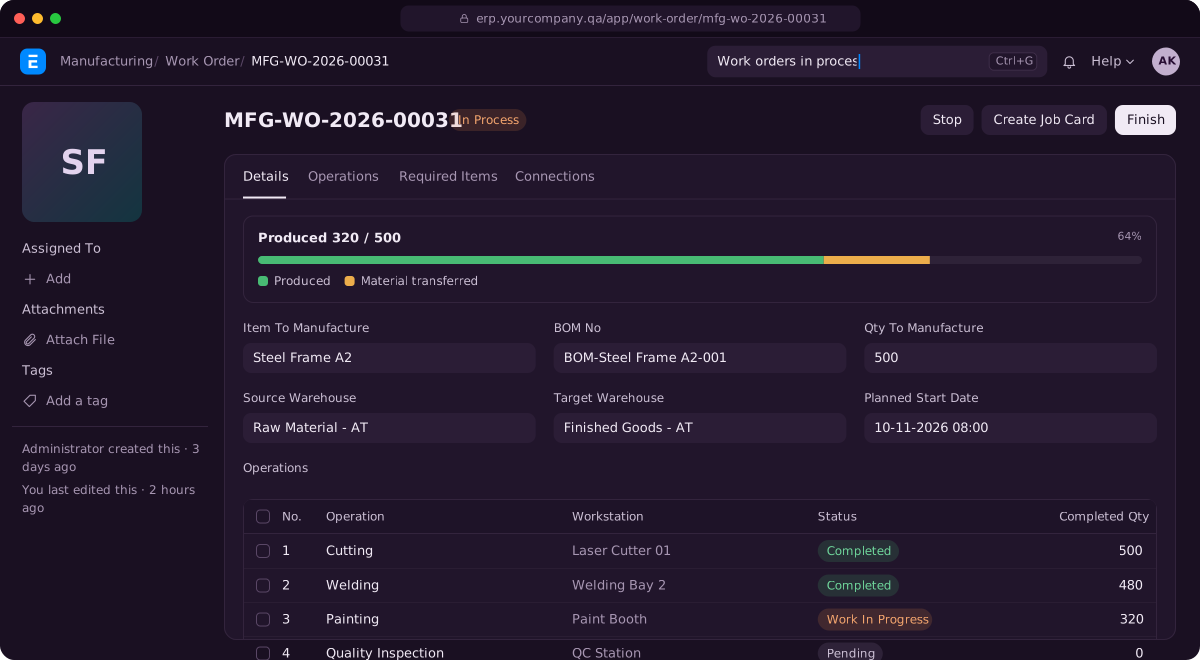
Supervisors record each step of the job on a job card, on screen. When a product goes through several operations, ERPNext creates a card for each operation and workstation, and the supervisor or operator records start and finish times and the quantity completed. Nobody collects paper sheets at the end of the shift to type them in.
The work order shows its progress as the steps finish, so the office knows where each job stands. Scrap and broken material can be recorded on the job card, and leftover material goes back to the store when the work order is closed.
How does a workshop see what each customer job really cost?
Compare the planned cost from the bill of materials with the actual cost recorded on each job’s work order. You see which job used more material or time than planned, while you can still ask why, instead of finding out from a lower profit at month end.
| On the floor | What the system records |
|---|---|
| The store issues raw material | Material cost, at the real purchase price |
| A machine works on the job | Operating time on the workstation, at its hourly rate |
| Some sheets are cut wrong | Scrap, recorded with its value |
| The job is finished | Finished goods in stock, with their actual cost |
Because stock, purchasing and accounts are in the same system, the figures come from what really happened, not from a separate costing sheet.
How do we give customers a certificate of conformance with each delivery?
Print it from the system. Some customers ask for a certificate of conformance with each delivery, so for the engineering workshop we built a conformance certificate print format: the certificate comes out of the system with the order details already on it, instead of being typed in a separate file.
Behind the certificate are the checks. Set up inspection templates with the points your team checks, and ERPNext can require an inspection before materials are received, during production or before goods are delivered. A failed check is recorded against the receipt or the job, so a problem leads straight back to the supplier or the run.
How do attendance, overtime and payroll work in a factory?
Bring fingerprint check-ins into the same system and let payroll pick them up. For the paper and plastic factory, we connected the attendance devices to ERPNext, so check-ins become attendance records without anyone copying them from the device.
From there, HR handles the rest in one place:
- overtime and salary rounding rules;
- leave;
- the WPS salary file, with the bank details your bank needs, and a monthly salary register, all in ERPNext HR and payroll.
At the engineering workshop, the HR team can also adjust overtime by hand on the salary slip when a case needs it. Either way, payroll no longer starts with someone adding up hours from printouts.
How does a factory or workshop in Qatar switch to one system without stopping work?
Set up and test with a few products and real orders, then roll out while the factory or workshop keeps running. We build the bills of materials with your production team, product by product, enter opening stock by store, and run real orders through before extending to the rest of the floor.
Training follows the jobs people do, and support continues after go-live.
See how production planning software on ERPNext and inventory and warehouse management work in detail, or read about our ERPNext implementation service. Still choosing a system? Our guide to ERPNext or Odoo in Qatar lists what to check, and if you run Odoo today, see how companies in Qatar move from Odoo to ERPNext.
Machines and tools can sit in the same system as fixed assets. See how the whole ERP system in Qatar fits together, and for what an ERP budget covers, read ERP cost in Qatar: what you actually pay for.
How we work with factories and workshops
- 01
Map your production
We follow how an order arrives, how materials leave the store, what happens on the floor and how goods are delivered and invoiced.
- 02
Build and test
We set up items, warehouses, bills of materials and documents, then test them with real orders before go-live.
- 03
Train and support
We train sales, stores, production, finance and HR, and stay with you after go-live, starting with a free warranty.
Our projects for factories and workshops in Qatar
- AL Tawheed Engineering Workshop
AL Tawheed Engineering Workshop: Engineering workshop · ERPNext
Bills of materials, work orders, quality checks and planning, linked to client orders and purchasing
- HyPack Paper and Plastic Industries
HyPack Paper and Plastic Industries: Paper & plastic manufacturing · ERPNext
Sub-assemblies taken from stock, with production linked to finance and payroll
ERPNext modules for factories and workshops
- From bill of materials to finished goods
From bill of materials to finished goods: Manufacturing · ERPNext
Production plans, work orders, job cards and quality checks, linked to stock and costs
- Raw materials and finished goods
Raw materials and finished goods: Inventory · ERPNext
Stock in every store, with batches, transfers and the real cost of each item
Systems for factories and workshops in Qatar: common questions
How much does an ERP system for a factory cost in Qatar?
There are no licence fees for ERPNext. The cost depends on how many products and bills of materials we set up, the number of companies and stores, the attendance devices we connect, documents such as conformance certificates, and hosting. We give you a fixed quote after a short review of your needs.
Do you work with engineering workshops as well as factories in Qatar?
Yes. Workshops usually work job by job from customer orders, while factories produce to a plan and keep stock, and ERPNext handles both: a work order from the sales order for a one-off job, or a production plan for repeat products. We have set up both kinds of business in Qatar. For a food company in Qatar, we also moved part of the meat production flow into the system.
Can a factory track its machines and their depreciation in the same system?
Yes. Machines and tools are recorded as fixed assets with their depreciation, next to production and accounts. We set up asset depreciation reports for a paper and plastic factory in Qatar.
Does a small workshop need the full manufacturing setup?
No. A small workshop can start with sales orders, work orders and stock, and add bills of materials with operations, job cards and quality inspections when its jobs need them. ERPNext has no licence fees, so you pay only for the setup you actually use, and more can be added later.
Can we see which customer orders are running behind?
Yes. Each sales order shows the work orders behind it and how far each one has gone, so the office sees which orders won't be ready by their delivery date while there is still time to act.
How is a factory team trained on ERPNext?
Training follows the jobs people do: storekeepers issue materials, supervisors record job cards, and finance closes the job costs, each in their own session. At a paper and plastic factory we trained the accounting, purchasing, sales, manufacturing, stock and HR teams, and set up a support portal for requests after go-live.
Can floor staff use the system in Arabic?
Yes. Screens, job cards and documents can be in Arabic and English, and each user picks their language. An operator can record a job card in Arabic while finance reads the same record in English, and training is given in both languages.
Running your factory from paper and spreadsheets?
Tell us what you make and how an order moves through your floor today, and we'll show you a demo in ERPNext.