Retail and delivery software in Qatar: branch stock, deliveries and payments in one system
Akwad Programming builds retail and delivery software for retailers in Qatar on ERPNext, and supports it from Doha. Check each order against branch stock, deliver by zone and time slot, record what drivers collect at the door and follow every delivery from the office, whether the order came from your website, app or branch.
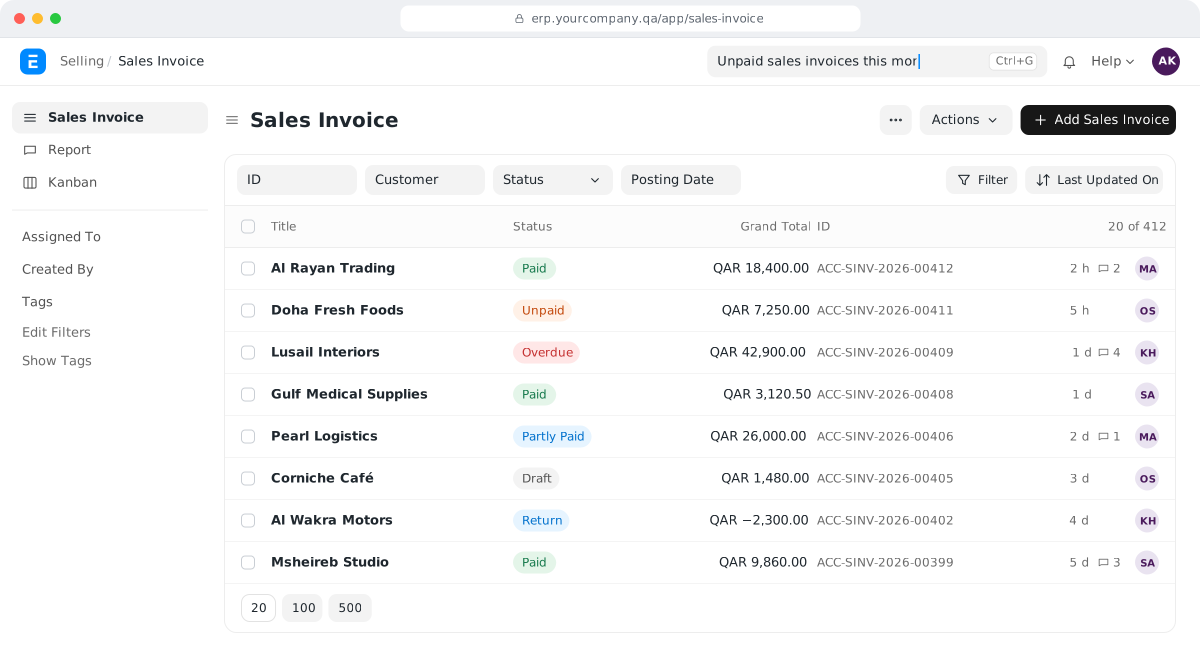
What slows retailers in Qatar down?
Retailers in Qatar slow down when online orders are retyped, orders are taken for items the branch doesn't have and payments are matched to orders in spreadsheets.
- Online orders retyped into the stock system
- Orders accepted for items the branch doesn't have
- Deliveries grouped by hand and by phone
- Payments matched to orders in spreadsheets
What does retail and delivery software on ERPNext include?
Built around ERPNext, so orders, stock, payments and deliveries share the same data.
Online store and app
An online store and iOS and Android apps on one back end, with catalogue, cart, checkout and customer accounts.
Branch stock
The customer's address decides the branch, and each order is checked against that branch's stock before it is confirmed.
Delivery zones and time slots
Delivery zones drawn on a map, time slots, pickup and delivery charges by address.
Trips and driver app
Orders grouped into delivery trips with road-based route planning, and a driver app for delivery status and collections.
Local payments
QPay (Qatar Central Bank), SkipCash, MyFatoorah, Sadad, card payments, Apple Pay and Google Pay, with refunds.
Customer updates
Order and delivery updates on WhatsApp and through push notifications.
Why do retailers and delivery companies in Qatar choose Akwad?
Akwad Programming connects branch stock, online orders, delivery trips and local payments in one ERPNext system for retailers in Qatar, with WhatsApp updates from an official Meta Tech Provider.
- One system: orders, stock, invoices and payments post straight to ERPNext
- Delivery tools: zones, time slots, trips and a driver app
- Coupons, wallets, loyalty points and subscriptions
- WhatsApp messages from an official Meta WhatsApp Tech Provider
- Arabic-first storefronts with right-to-left layouts
How do branch, online and delivery sales share one stock and one set of accounts?
Run the branch tills, the online store and apps and deliveries on one ERPNext system, so each order creates the sale and the invoice, the payment and the stock movement in one go. Nobody copies an order from one screen to another, and the payment and stock value post to ERPNext accounting at the same time.
At many retailers in Qatar, the online store was added later, on a separate platform. Orders land in a dashboard or an inbox, someone types them again into the stock system, and finance matches payments to orders in a spreadsheet at the end of the day. Every step is a chance for a typo, a missed order or a refund nobody recorded.
With one system, your online store and your iOS and Android apps run on one back end, with the catalogue, cart, checkout and customer accounts in one place. Prices and stock come from ERPNext, so a price change reaches the website and the apps without a second update.
For a food and delivery company in Qatar, that one flow covers the whole journey: the customer checks what is available and pays, the branch prepares the order, and it is dispatched and delivered. Your supervisors follow each order through those stages in the same system, so they know which orders are still waiting and which are already out. We have also connected the delivery apps Snoonu and QBas, as well as custom delivery apps we built, so their orders reach the same stock.
At the branch, Akwad Programming sets up the ERPNext point of sale with receipt printers, cash drawers, Arabic receipts and offline use. For the till itself, see CRM and POS software on ERPNext.
How do we stop taking orders the branch can’t fill?
Let the customer’s address choose the branch, and check that branch’s stock before the order is confirmed. If an item isn’t there, the customer knows at checkout, not when the driver calls.
On one of our large projects, for a food and delivery company, the address decides which branch serves the customer, which products they see, how the order is delivered and what it costs. Delivery zones are drawn on a map, customers choose a time slot or pickup, and an order can be split between two locations when one can’t fill all of it. For another online store, we built checkout around the Qatari address format, with shipping charged by address.
Pickup works the same way. The customer chooses the branch and the time, and the order is prepared from that branch’s stock.
How do we plan delivery trips?
Group orders into trips by area and time slot, and let the system plan each route on real roads. Your coordinators check and adjust the plan instead of building it by hand every morning.
At a food retailer we work with, coordinators were regrouping orders by hand, because the earlier automatic grouping looked only at location and didn’t match how drivers actually move. We replaced it with road-based route planning using OSRM and VROOM, two open-source routing tools. The plan takes into account:
| What the system looks at | What it means for the plan |
|---|---|
| Driving times on Qatar’s roads | Trips follow real roads, not straight lines on a map |
| Each vehicle’s weight and volume limits | No van is loaded with more than it can carry |
| Driver shifts | Each trip fits inside the driver’s shift |
| Orders that don’t fit | They are flagged so a coordinator decides |
Coordinators can still change any trip before it goes out.
How do drivers update deliveries and collect payment?
Drivers work from a mobile app that lists their trip and the details of each order, and they record the delivery status and any payment collected at the door. Your office sees each status as it changes, without calling the driver. Coordinators can also see which trips are finished and which drivers are still on the road.
Payments collected are recorded against the order, so finance can check the cash each driver hands in against the orders they delivered. Reports compare each actual arrival with the time slot promised to the customer, so you can see which areas or times keep running late.
How do online payments match our orders?
The customer pays through a local gateway at checkout, and the payment is recorded against that order in ERPNext. Refunds go back through the same gateway and are recorded too, so finance doesn’t chase them in a spreadsheet.
We have connected the gateways retailers in Qatar use. At a food and delivery company, Visa and Mastercard go through the QNB Payment Gateway (CyberSource) and debit cards through QPay (Qatar Central Bank). A trading company’s shopping apps take QPay with refunds and the QNB Payment Gateway. Other projects use SkipCash, MyFatoorah, Sadad, Apple Pay and Google Pay. Read more about our payment integration work.
Apple Pay and Google Pay turn checkout into a tap on the phone, so customers don’t have to type card details on a small screen.
How do delivery customers in Qatar get updates without calling the branch?
Send order and delivery updates on WhatsApp and as push notifications, straight from the system, at each stage. Customers know their order is on the way without calling to ask.
At a food and delivery company we work with, WhatsApp campaigns and delivery notifications replaced SMS, and WhatsApp surveys collect customer feedback. Akwad Programming is an official Meta WhatsApp Tech Provider, so we connect the WhatsApp Business API directly. Push notifications reach customers who use your app, and WhatsApp reaches those who ordered on the website.
How do we run seasonal products such as Udhiyah coupons in Qatar?
Set each seasonal product up with its own rules on the same platform as your orders, so a coupon or a pickup is recorded like any other sale. For a food company in Qatar, we built Mubadara and Udhiyah (Eid sacrifice) coupons with eligibility checks, pickup points and QR code scanning in an operator app, plus ordering for Walima feasts. Each one runs on the same platform with its own rules, instead of a separate system for each season. For everyday coupons, wallets and loyalty points in an online store, see e-commerce development.
See how the whole ERP system in Qatar fits together, and for what an ERP budget covers, read ERP cost in Qatar: what you actually pay for.
How we work with retailers
- 01
Plan the store and delivery
We agree your products, branches, delivery zones, time slots and payment methods with you.
- 02
Build and connect
We set up branch stock, delivery zones and the driver app, connect your store or apps and your payment gateway, and test real orders from branch to doorstep.
- 03
Go live and support
We go live, train your team on orders, stock and dispatch, and keep the system updated.
Our projects for retail and delivery companies in Qatar

Widam Food: Retail & delivery · Frappe platform
One of our large projects: online store, mobile app, payments, delivery trips and a driver app
- General Product Trading
General Product Trading: Retail · Mobile commerce
Shopping apps with QPay payments and refunds, and the QNB Payment Gateway
ERPNext modules and services for retail and delivery companies
- Online stores and apps
Online stores and apps: E-commerce
Web stores and shopping apps connected to ERPNext, in Arabic and English
- Driver and shopping apps
Driver and shopping apps: Mobile apps
Driver apps for trips and collections, and shopping apps connected to ERPNext
- Branch stock
Branch stock: Inventory · ERPNext
Stock in every branch and warehouse, checked before each order is confirmed
Systems for retail and delivery in Qatar: common questions
Can customers in Qatar order for a set delivery day and time?
Yes. At checkout, customers choose a delivery day and one of the time slots set for their zone, and the branch prepares the order for that slot instead of as soon as it arrives. The same rules apply to pickup, so the order is ready when the customer comes to the branch.
Can the same system run our branch point of sale (POS)?
Yes. ERPNext includes a point of sale for branches, so till sales, online orders and deliveries use the same stock and the same customer records. A product sold at the till disappears from the online store's stock straight away, and finance sees every channel in one set of accounts.
Can a single shop use this system, or is it only for chains?
A single shop can use it too. The online store, stock, payments and delivery work the same way with one branch, and the branch rules simply have one option. When you open a second branch, it is added to the same system instead of starting a new one.
Can product names and descriptions be in Arabic and English?
Yes. Each product holds its Arabic and English name and description in ERPNext, and the store and apps show the customer's chosen language. Your team edits a product once, and both language versions, prices and stock stay together.
Can we see online and branch sales in one report?
Yes. Every sale is recorded in ERPNext, whether it came from the website, the app or a branch till, so sales reports show each channel side by side, by product and by branch. Nobody has to merge an online export with the branch figures at the end of the month.
We already have an online store. Where do we start?
Usually by connecting your current store to ERPNext, if its platform allows it, so orders, stock and payments stop being retyped. CS-Cart stores, for example, can be connected. A new store or new apps can come later, once orders and stock already run from one system.
How long does it take to launch retail and delivery software in Qatar?
It depends on the number of branches and products, the apps you need and the payment gateways, and the timeline is written in your quotation. You can start with online orders and branch stock, then add the driver app and trip planning, so each part goes live as soon as it is ready.
Selling online and delivering across Qatar?
Tell us what you sell, from how many branches, and how you deliver, and we'll show you a demo in ERPNext.